THE
UPS AND DOWNS OF
TEACHING
AT LONGWOOD
The Upside...
Good students who want
to learn

"Hey, I can see my house
from here!"
Willis Mountain Field
Trip, 1997


Nice students who offer
a kind word

Comments
like that make it all worthwhile!
The Downside...
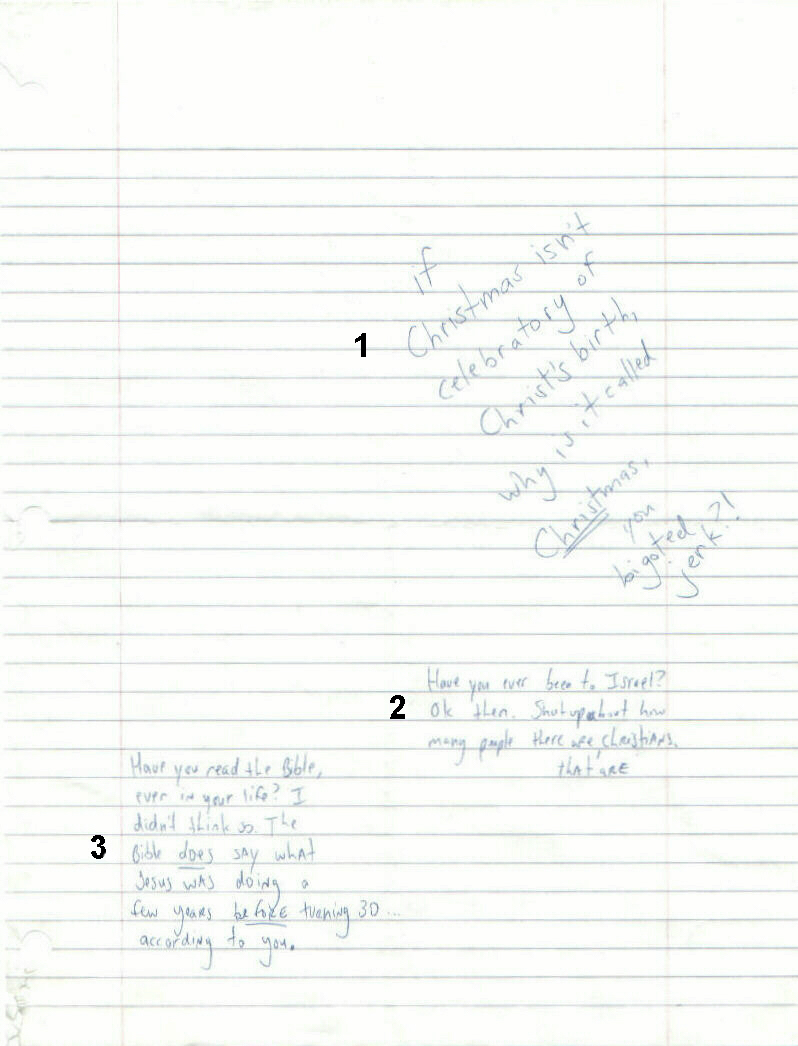
Now to address each of the student’s
concerns:
1 My comment about Christmas
had nothing to do with the fact that it celebrates the birth of Jesus but
why it is celebrated on December 25. I love Christmas and celebrate
it vigorously. If the student had bothered to listen to what I said,
he/she would realize that I was pointing out that Christianity developed
within the context of the Roman Empire and that while Christmas commemorates
the birth, the fact that it is celebrated on December 25 has nothing to
with when Jesus was born. Christmas is a celebration of a new light
in the world; I can’t think of a better time to celebrate that than after
the winter solstice (the setting for the Roman Saturnalia Festival).
The actual time of year that Jesus was born is of little consequence to
Christianity in general. Christmas commonly was not celebrated at
all until recent centuries and even was outlawed in colonial New England
for a time. Also, while the “jerk” part may be a matter for debate,
I am a Christian, so I fail to understand where the bigotry comes in.
2 Have I ever been to Israel?
No, but I hope to soon. Nonetheless, an examination of data pertaining
to Israel (CIA World Factbook, 1997 Internet Edition) reveals that only
two percent of the population there is Christian (appoximately 108,400
people), which supports my contention that Christianity is no longer widely
practiced there. I never said there are no Christians
in Israel. In fact, I pointed out that an entire quarter of Jerusalem
is devoted to Armenians -- the first nation of people as a whole to convert
to Christianity (consult the map I handed out).
3 Have I read the Bible?
Several times and not nearly enough. I keep a copy in my office for
just these kinds of emergencies (sorry traditionalists, I use the NIV).
According to our flawed calendar, Jesus was born in 4 or 5 BCE. Jesus’
last appearance as a child was at age 12 (CE 7 or 8), when he was found
preaching in the temple (Luke 2:41-52). Jesus’ next appearance was
at his baptism around CE 26, when he would have been 30 or 31 (Luke 3:23,
for example). What Jesus was doing from the ages of 12 to 30 is one
of the great mysteries of the Bible. In the context of Palestine
during Jesus’ lifetime -- when life expectancy was in the 30s -- a geographer
might very well ask where Jesus was, what he was doing, and who he was
talking to during the balance of his lifetime and in the crossroads
of the Ancient World. Does it matter in the broader context
of Christianity? No, but it’s fun to think about. Unfortunately,
the writers of the New Testament showed no concern over the gap and although
certain Gnostic texts reveal details about Jesus’ childhood, they too are
silent about the intervening 18 years. If the student has some secret
knowledge, please share it with us!
I hope that my explanations vindicate me.
It might also help the student to consult
Luke
6:37-42.