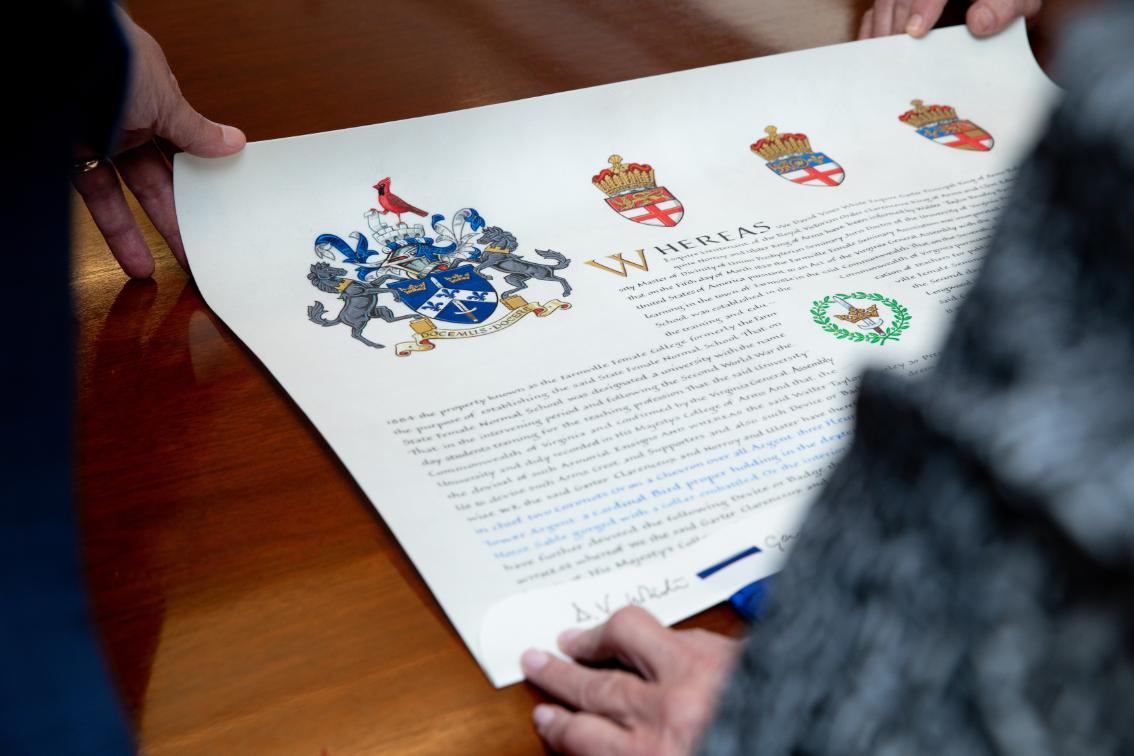
Amid America’s 250th anniversary in 2026, Great Britain recognized Longwood University with an official coat of arms. University leadership received the letters patent in June 2026 at the British Embassy in Washington, D.C.
Ordinarily, institutions are granted armorial bearings within the United Kingdom and Commonwealth of Nations, though the British College of Arms at times considers American institutions in certain circumstances, most notably historical significance and legacy. Longwood’s name traces to medieval Scotland, and the University’s home of Prince Edward County was founded in 1754 in honor of King George III’s younger brother. Since the time of the Second World War, a portrait of Prince Edward has hung prominently in the County’s Board of Supervisors chambers. Founded in 1839, Longwood is one of America’s hundred oldest colleges and universities.
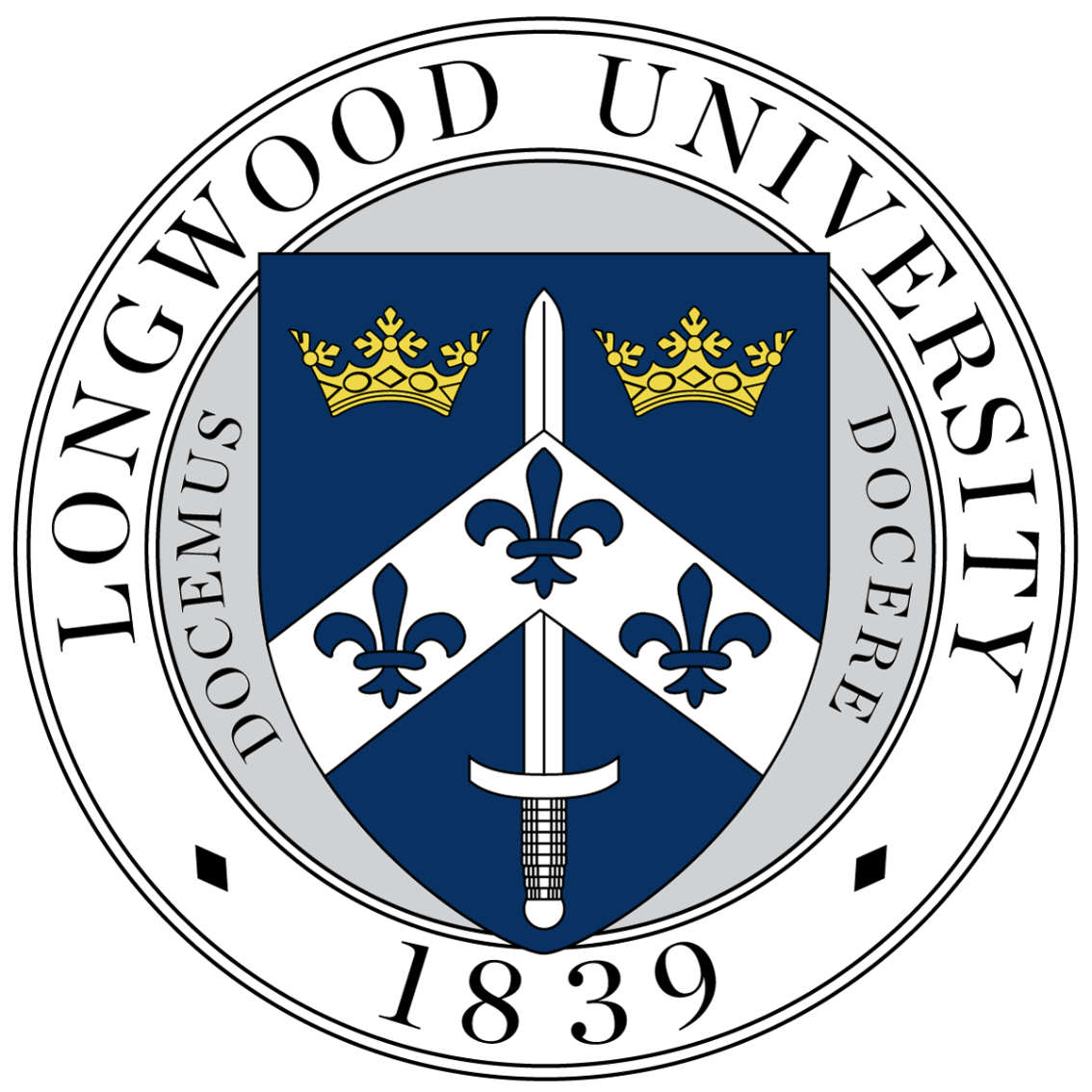
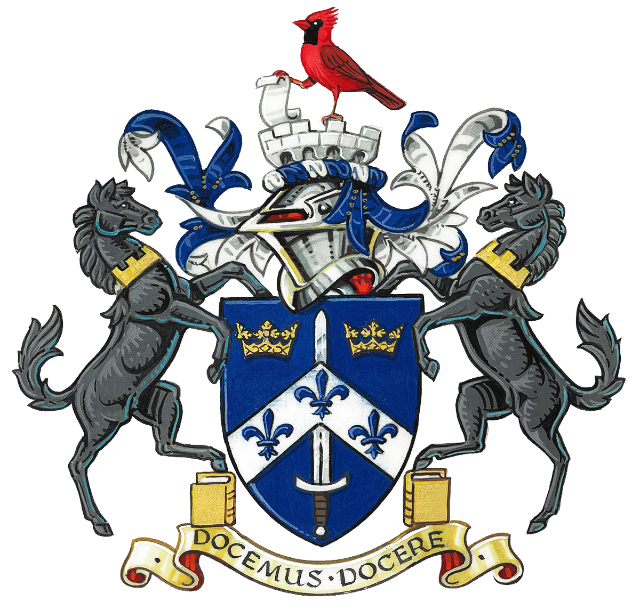
Longwood’s coat of arms is comprised of three distinct elements, each reminiscent of Joan of Arc, the University’s patron hero. Two appear on Joan of Arc’s family arms: the three fleur-de-lys and sword; while the chevron is not only a distinguishing mark on modern military uniforms, but an ancient symbol of courage and bravery.
The blue field behind a white chevron echoes Longwood’s traditional colors.
In the formal armorial bearings, a cardinal, symbolizing Longwood’s place in Virginia history, sits atop a battlement and holds a book in its outstretched foot, symbolizing the educational mission of the Commonwealth’s third-oldest public institution of higher learning.
The two black horses that support the crest are also reminiscent of Joan of Arc. Charles II, Duke of Lorraine, met 17-year-old Joan of Arc in Nancy, France, in January 1429 just months before her military campaign at Orleans. Charles II, impressed by the young woman, gifted her a black horse that she rode 270 miles to Chinon to meet with the French monarch.
Below the Arms is the Longwood motto, Docemus Docere, meaning “we teach to enlighten,” on a scroll.
As described in the official letters patent from the British College of Arms
Arms: Azure a Sword erect proper between in chief two Coronets Or on a Chevron over all Argent three Fleurs de Lys Azure
Crest: Upon a Helm with a Wreath Argent and Azure; Upon the upper part of a Tower Argent a Cardinal Bird proper holding in the dexter foot a Scroll unrolled Argent; Mantled Azure doubled Argent
Badge: Within a Laurel Wreath Vert a Sword erect proper enfiling a Coronet Or
Supporters: On either side a Horse Sable gorged with a collar embattled Or the interior hind leg resting on a Book Or leaved Argent

In 2022, as her term as Rector came to an end after her full two-term tenure on the Board of Visitors, Pia Trigiani’s mind turned to lasting symbols of great universities. She was particularly thoughtful about how her own affection for Joan of Arc, Longwood’s patron hero, mirrored that of her predecessor as Rector, Marianne Radcliff ’92. For both of the women, Joan of Arc had become a meaningful figure in their lives, as is true for generations of Longwood students. Both were instrumental in securing the Joan of Arc statue that sits at the south end of campus, sculpted by the Queen’s Sculptor in Ordinary Alexander “Sandy” Stoddart and dedicated in 2018—when Radcliff was Rector and Trigiani was Secretary of the Board of Visitors. In conversation, their attention turned to the coat of arms that adorns the statue’s base and also appears near the north doors of Allen Hall.
An idea crystallized: could Longwood itself be granted a traditional coat of arms from Great Britain as a lasting symbol of the University as it approaches its 200th anniversary? A small committee led by David Whaley, Longwood’s design director, was delighted to find that the British College of Arms was eager to grant armorial bearings to one of the nation’s hundred oldest colleges and universities and quickly assigned one of the four pursuivants in ordinary to draft a petition to the Earl Marshal.
As the petition was drafted, a small group of philanthropists who shared Trigiani’s and Radcliff’s affection for Joan of Arc committed to donating the funds required to secure armorial bearings. They recognized the importance of symbols for historic institutions and were excited by the prospect of supporting the creation of a heraldic achievement that would itself become a cherished symbol for the University.
In January 2025, the College of Arms accepted Longwood University’s petition, prepared by the Rouge Croix Pursuivant of Arms in Ordinary Thomas A. Johnston. Over the next months, Johnston worked with the Longwood committee to identify design elements that spoke to the University’s history, traditions, and mission, with a particular emphasis on its connection to Joan of Arc.
The approval process concluded in early 2026, and that April, ahead of King Charles’ visit to America and historic address to Congress ahead of the nation’s 250th anniversary, Longwood was informed that its armorial bearings were being packaged to be delivered to the British Embassy in Washington, D.C. that summer.
In his speech to Congress, King Charles noted the cultural, historic, and educational ties that bind our two nations. “Our ties in education, research, and cultural exchange empower citizens and future leaders,” he said. “The story of the United Kingdom and the United States is, at its heart, a story of reconciliation, renewal, and remarkable partnership.”
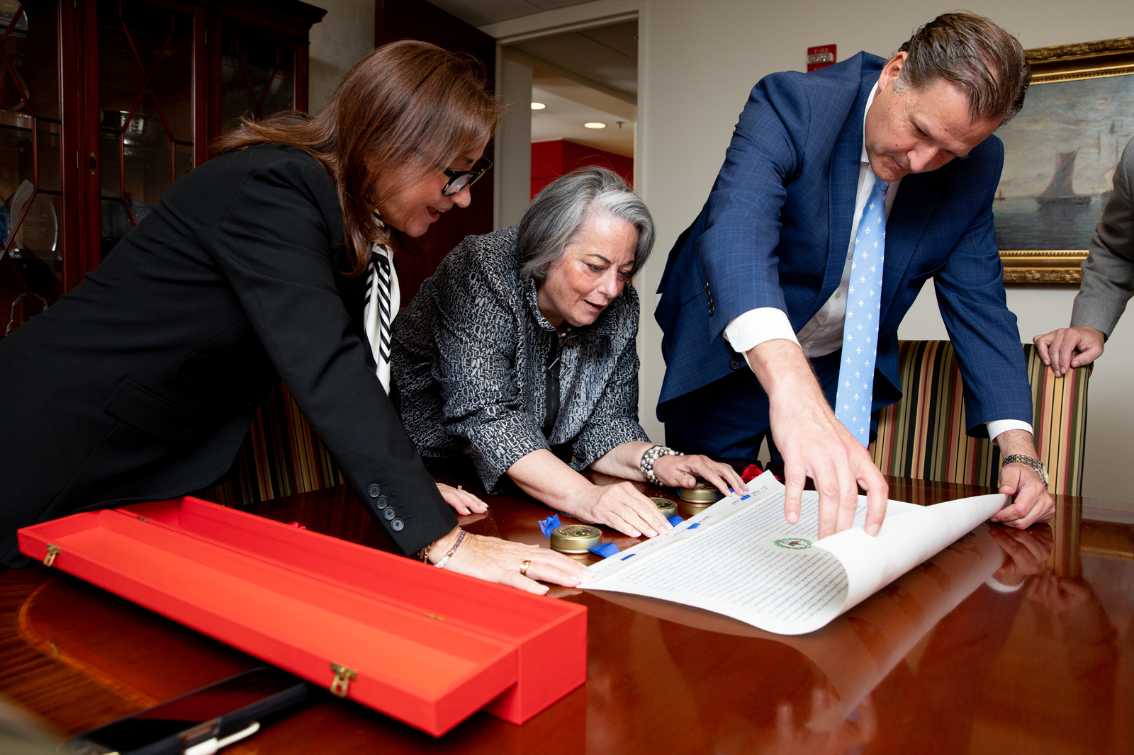
In June 2026, the armorial bearings were officially presented to the pair of former Rectors and President W. Taylor Reveley IV at the British Embassy in Washington, D.C.