PHYSICS 324
Thermodynamics
Spring 2004
Instructor: Dr. C.D. Ross
Office:
Stevens 104
Office telephone: 804-395-2587
Office Hours: MWF 10:45-12:00
Course Description: A study of the thermal properties of matter, including the properties of pure substances, energy transfer and the first and second laws of thermodynamics. The course will stress practical applications of the concepts, including power and refrigeration cycles. Prerequisite: Physics 101, 102 or 201, 202.
Texts: Cengel and Boles, Thermodynamics:
An Engineering Approach, McGraw-Hill, 4th edition, 2002.
Course Objectives: To provide a
firm grounding in the concepts of temperature, work, heat, compressibility,
entropy and the laws of thermodynamics.
Course Schedule:
Chapter 1: Basic Concepts of Thermodynamics
Chapter 2: Properties of Pure Substances
Chapter 3: Energy Transfer by Heat, Work and Mass
Test 1: Wednesday February 11
Chapter 4: The First Law of Thermodynamics
Chapter 5: The Second Law of Thermodynamics
Chapter 6: Entropy
Test 2: Wednesday March 24
Chapter 8: Gas Power Cycles
Chapter 9: Vapor and Combined Power Cycles
Chapter 10: Refrigeration Cycles
Test 3: Wednesday April 21
Final Examination: Wednesday April 26, 11:30 a.m. - 2:00 p.m.
Course Requirements:
(1) Three tests; (2) Final exam; (3) Homework problems as assigned.
Assignments are due at 12:00 a.m. on the due date. Late homework
will not
be accepted unless due to an excused absence. Format for problems
will be
discussed in class.
Grading: Your grade for the semester is calculated from the formula
below:
Point total = Highest test (25%) + Next highest test
score (25%) + Final Exam (25%) +
Homework (25%)
Your final grade is determined by dividing your point total by 100 possible
points and computing a percentage. This percentage is graded
according to
the following scale:
A+ 98 and above; A 94-97; A- 90-93; B+ 88-89; B 84-87; B- 80-83; C+
78-
79; C 74-77; C- 70-73; D+ 68-69; D 64-67; D- 60-63; F+ 58-59; F 54-57;
F-
53 and below
Attendance Policy: All assignments
are expected to be handed in on time
and all tests taken at the assigned time unless prior arrangements
have been
made. Exceptions may be made in the event of a certifiable emergency.
If
you miss more than 25% of the class meetings you will receive a final
grade of
F for the course. This includes excused and unexcused absences
and there
are no exceptions to this rule. It is your responsibility
to sign the attendance
sheet. Signing for anyone else is an honor offense. If you are
chronically late to class (i.e. more than twice), you will be marked absent
for each subsequent incident of tardiness.
Honor Code: Students are expected
to live by the Longwood College Honor
Code. If you are found responsible by the Honor Board for an Honor
Code violation in this class you will receive a grade of F.
Other Requirements: Each student
must have a calculator capable of
performing trigonometric and logarithmic operations. You must
come to class properly attired; in particular, you must wear shoes.
If you sleep in class, you will be told to leave. Please turn off all pagers
and cell phones before entering the classroom.
Bibliography: You may want
to refresh your memory on some topics by
looking back in an introductory physics text.
Students with Special Needs:
If you have a condition which requires special
attention or accomodation, please discuss your situation with me.
Back to Physics 324 Home Page
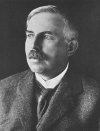
Ernest Rutherford (1879-1955)
"All science is either physics or stamp collecting."