

The seminar itself was scary enough: the analysis of a psychological horror novel and the classic ghost stories that formed the book’s backstory. But what grew out of the seminar was also a little scary—or at least verging on fantastical.
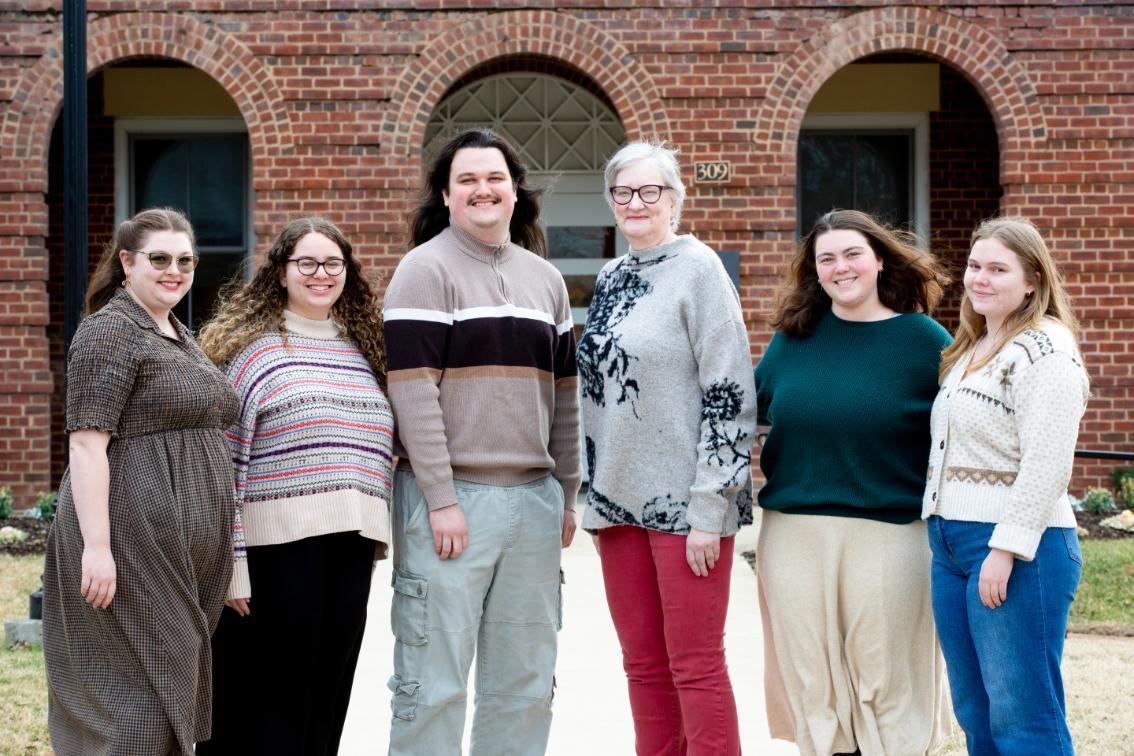
Five students who took the seminar submitted proposals to present their research at the 2026 International Association for the Fantastic in the Arts conference. All five were accepted.
“I was absolutely floored that all five of them were accepted. This is a scholarly conference that accepts very few undergraduates,” said Dr. Rhonda Brock, the Longwood professor of English who taught the seminar, titled The Ghost Story Tradition in the U.S. She encouraged her students who took the class in spring 2025 to consider submitting proposals to the conference. Over the summer and during the fall semester, Brock coached them through writing their proposals.
Their collective hard work paid off.
In March, the five students will travel to Florida to present their papers, with most of their expenses covered by Longwood.
I thought this conference would be a great opportunity for me professionally. I want to learn more about horror, sci-fi and fantastic genres so I can better serve everyone who walks through my library's doors.
Madeline Moeller '26
“I thought this conference would be a great opportunity for me professionally,” said Madeline Moeller ’26, an English literature major who has wanted to become a librarian since she was in middle school. “I want to learn more about horror, sci-fi and fantastic genres so I can better serve everyone who walks through my library’s door.”
Edison Moscar ’26 also is an English major, with a concentration in secondary education. “I decided to submit a proposal because my topic is one that I am incredibly passionate about,” she said, adding that she’s looking forward to sharpening her public-speaking skills from the experience of presenting her paper and answering questions from the audience.
Brock will be right there with her students. An active member of the International Association for the Fantastic in the Arts for the last 30 years, she will be leading one of the sessions and presenting her own research, which focuses on gothic and horror literature, specifically the works of Peter Straub.
To those who think horror and gothic fiction is less serious than other genres of literature, Brock and her students say think again.
Horror fiction tends to be closely tied to culture and history. This literature is worthy of study because it reveals social anxieties and social pressure points that tell us about ourselves.
Dr. Rhonda Brock, professor of English
“Horror fiction tends to be closely tied to culture and history,” said Brock. “This literature is worthy of study because it reveals social anxieties and social pressure points that tell us about ourselves. Also, ghost stories and horror fiction have a history of being a respectable genre of literature embraced not only by Poe and Shelley but also by Hawthorn, Dickens, Edith Wharton and Henry James.”
Zoe Nash ’26, another English major participating in the conference, added: “Horror goes back so much further than we realize. Now we’re able to connect these older works to modern literature. A lot of horror fiction pulls from real life, bringing to light things that we might rather ignore,” she said.
These and other themes were discussed in the seminar, which zeroed in on Straub’s novel Ghost Story. Students found the class enriching—and not just academically.
“This class was the best part of my day—the best part of my week,” said Nash. “It’s my favorite class I’ve ever taken in college.”
Moeller agrees.
“It felt like a book club with my closest family and friends. Of course, we still had assignments and did actual work, but I enjoyed all of it so much that it didn’t feel like work. I felt, and still feel, like all of my classmates and Dr. Brock especially genuinely care for me and want me to succeed in everything I do.”