

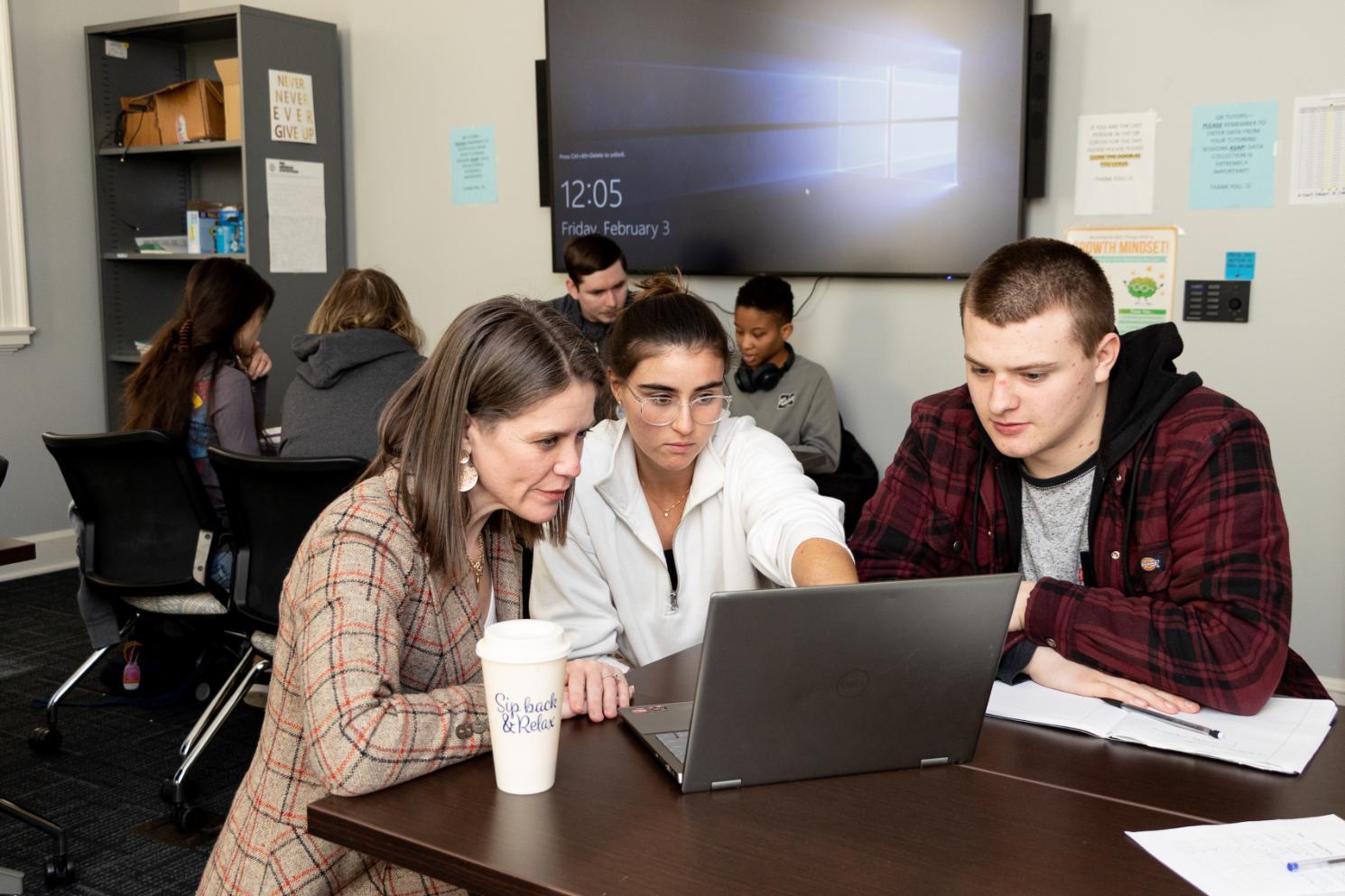
Longwood University will launch a new bachelor of science in data science program beginning this fall, giving students an opportunity to develop in-demand skills in data analysis, statistics and programming, while preparing for careers in one of the nation’s fastest-growing fields.
The new program is designed to appeal to students who enjoy solving problems and want to make an impact through data-driven decision-making. Real-world data and practical applications are infused throughout the program so that students will have the opportunity right from the start to tackle authentic problems.
By graduation, students will have gained hands-on experience using data science to solve meaningful problems for real organizations.
Dr. Toni Sorrell, associate professor of mathematics education and chair of the Department of Mathematics and Computer Science
“Our curriculum immerses students in the complete data life cycle, equipping them with the skills to collect, clean, analyze and effectively communicate data-driven insights,” said Dr. Toni Sorrell, associate professor of mathematics education and chair of the Mathematics and Computer Science Department. “Courses will help students build skills in statistics, programming, machine learning, data visualization and data storytelling, making the field accessible to students at all levels of experience. By graduation, students will have gained hands-on experience using data science to solve meaningful problems for real organizations.”
Students pursuing a degree in data science will gain hands-on experience using industry-standard tools such as Python, R and SQL, applying them to real-world datasets in fields such as sports, health, business and social issues.
[The program] reflects both the evolving needs of today’s workforce and our commitment to providing students with meaningful, career-focused learning opportunities.
Dr. Roger Byrne, former dean of the Cook-Cole College of Arts and Sciences
“The launch of our data science program is an exciting milestone for Longwood and the students we serve,” said Dr. Roger Byrne, outgoing dean of the Cook-Cole College of Arts and Sciences, who retired last month. “It reflects both the evolving needs of today’s workforce and our commitment to providing students with meaningful, career-focused learning opportunities. Data touches nearly every aspect of modern life. This program will give students the technical skills, analytical mindset and experience they need to succeed in an increasingly data-driven society.”
Data science majors will be prepared to pursue a variety of data-driven careers, building skills in predictive modeling and analytics that apply to roles such as data analyst, business intelligence analyst, data scientist, statistical analyst and quantitative analyst, across industries ranging from healthcare and finance to sports, government and nonprofit organizations.
The program will also provide a strong foundation for students interested in continuing their education through graduate study in data science, statistics, computer science, business analytics and related fields.
One of the program’s most distinctive features is its yearlong capstone sequence, Practice of Data Science Consulting I and II. During the experience, students spend approximately 160 to 180 hours working on a consulting project for a client. Faculty will arrange partnerships with businesses, nonprofit organizations and government agencies across the region, allowing students to focus on applying their skills rather than searching for opportunities.
Working in teams under faculty mentorship, students will meet with clients, analyze data and develop solutions to real-world challenges. Their work includes creating project proposals, providing regular client updates, cleaning data, conducting analyses using industry tools, developing visualizations, writing professional reports and presenting findings and recommendations to clients and faculty.
Sorrell noted one of the strengths of Longwood’s data science program is its flexibility. The program is designed to give students room to pursue a minor or even a second major in a complementary field, giving them the opportunity to tailor their degree to their interests and career goals.
“Want to work in environmental science? Pair data science with a geographic information science (GIS) minor to analyze spatial and environmental data. Interested in business? Combine it with a minor in business administration or economics to apply data-driven decision-making in the corporate world,” Sorrell said. “By combining data science with another area of study, you’ll graduate with both strong technical skills and domain-specific knowledge, an especially powerful combination in today’s job market.”
In other new academic offerings news, and pending approval from the State Council on Higher Education in Virginia (SCHEV) and the Virginia Department of Education, two additional concentrations within the Biological and Environmental Sciences Department will be available beginning this fall: A biomedical and health science concentration for biology majors and a teacher preparation in earth sciences concentration for integrated environmental science majors.
The biomedical and health science concentration is designed to help students develop the skills and foundational knowledge to work in the private sector in careers such as lab scientists or anatomical scientists and in the field of reproductive health. The concentration also satisfies many prerequisite course requirements for admission to a wide range of health-related graduate or professional programs, such as biomedical research, genetic counseling optometry, physician assistant, physical therapy and occupational therapy.