


Shortly after graduation, Montana Nelson Dellinger ’19 began leading a double life. An office administrator at a Richmond HVAC company by day, she moonlighted as a traveling piano and clarinet instructor in her downtime.
The former paid her bills, while the latter allowed her to pursue her lifelong passion for music. As a musician, she says that’s a typical setup—holding a steady job for a paycheck while finding other avenues, be them performing or teaching, to stay engaged with music.
For a time, she was content. She enjoyed providing music lessons to her grade-school students, and she enjoyed the steady predictability of her day job—especially given her familiarity with an HVAC company where her stepfather, William Bliss, had worked for more than 35 years.
But Dellinger and her stepfather had more in common than their employer. Both were musicians, and both shared the same inability to live a life without music. So when Bliss retired in 2022 and set out to fulfill a long-deferred dream, he recruited Dellinger to make it happen.
“My stepfather was a lifelong musician, and after he retired, he wanted to open a music studio,” said Dellinger, who plays clarinet and was a member of the Longwood Wind Symphony as an undergraduate. “He considered franchising a national studio, but the business model wasn’t something he believed in as a music teacher. He wanted to do something different, something smaller for our community where we’re really intentional about the students we serve and what we do with it.”
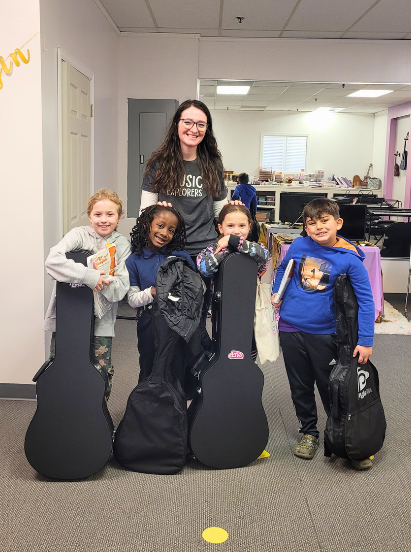
Now, three years since its opening, what started as a shared vision between Dellinger and her stepfather has crescendoed into the thriving Music Explorers Studio in Chesterfield, Virginia. The aptly described “family-owned and family-centric” studio provides a variety of lessons and classes primarily for students ranging from infants to 17 years old—though Dellinger says she’s had students as old as their 60s come in to learn an instrument. Dellinger, a music major and business minor, runs the studio alongside her husband and business partner Sam Dellinger ’19, himself a Longwood history major.
Bliss, however, passed away unexpectedly in 2023—shortly after the studio’s opening—leaving Dellinger to carry forward her stepfather’s vision in memoriam. She has done exactly that, assembling a team of educators—which has included multiple Longwood alumni—who teach more than 150 local students annually. Bliss’ legacy, Dellinger says, persists in Music Explorer’s mission and in the joy exuded on the face of every budding musician who walks through their doors.
“Our goal is to create lifelong musicians,” Dellinger said. “Music is such a great part of life, and we want to be able to give our students the knowledge and skills to engage with it meaningfully.”
But as Dellinger and Bliss quickly found in the early days of their shared venture, starting a music studio from scratch was daunting. Questions of curriculum, group versus private lessons, differentiation between students based on age and skill, and how to build a diverse staff were all challenges they would have to address if their shared dream were to become a sustainable reality.
Fortunately, Dellinger had already seen, firsthand, the perfect blueprint for such an endeavor at Longwood. And she knew exactly whom to consult for guidance.
“My junior year, I took a music pedagogy class with Dr. Lisa Kinzer and Dr. Kristen Topham,” she said. “As part of it, we taught students through the Longwood Center for Community Music. I loved that experience. Being that kind of teacher was really impactful and pivotal for me. It made me think I could do that one day.”
Born from a shared idea between Kinzer and Topham and launched in 2016, the Longwood Center for Community Music (LCCM) is a faculty-led, community-driven initiative that offers music lessons for local children ranging from infants to high-schoolers. The center utilizes both group and private lessons for a range of instruments and has grown to engage more than 100 families annually, in turn becoming a musical touchstone for students in and around Longwood’s hometown of Farmville.
To meet the booming demand for the LCCM, the center also employs upperclassman music majors who have gone through the department’s pedagogy classes—just like when Dellinger was a student. For Lancers like Dellinger, who enrolled in Longwood’s music program with the intention of becoming a performer, that experience teaching music can be eye-opening.
After I started teaching at the Longwood Center for Community Music, for the first time I saw teaching as a way I could keep music in my life. Kids love me, I love kids, and the teaching was always fun for me.
Montana Nelson Dellinger ’19
“When I started as a freshman, I was a performance major, and that’s what I graduated as,” she said. “But other than performing, I wasn’t entirely sure what I was going to do after college. After I started teaching at the LCCM, for the first time I saw teaching as a way I could keep music in my life. Kids love me, I love kids, and the teaching was always fun for me.”
Dellinger notes that the foundation of Music Explorers borrows heavily from the LCCM and is informed by the guidance she still occasionally seeks out from Topham and her fellow Longwood music faculty. One example is an early piano curriculum Topham recommended, which Dellinger still uses to teach her classes today.
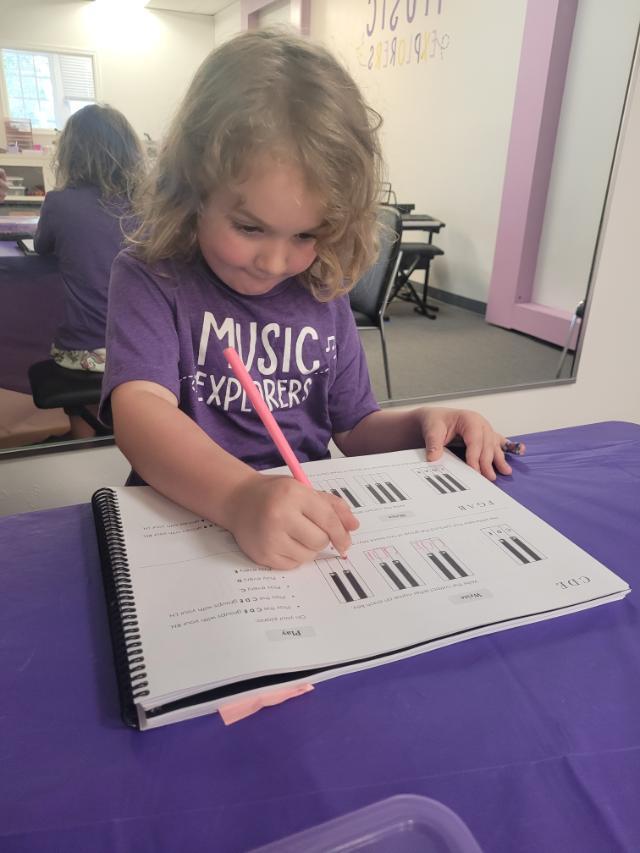
Moreover, at Music Explorers, just like the LCCM, young children take part in group sessions that are movement-based and introduce them to the basics of rhythm and music vocabulary, while older students go on to specialize in specific instruments and delve into more complicated aspects of music. That “block-by-block” structure is a tried-and-true method that the LCCM has leveraged through its decade of existence, and one in which Dellinger saw the benefits up close as an instructor.
“You start slowly, and you make some building blocks,” Dellinger said. “There’s a foundation where you’re learning what a piano actually is and how to play it. What are the white keys, and what are the black keys? What’s a long note, and what’s a short note? Over time, the ‘long note’ becomes a ‘whole note,’ and the short note becomes a ‘quarter note.’ You introduce a small concept, and you slowly build on it every week.
Over time, it’s like building a very strong tower. But you have to have that strong foundation first.”
In the three years since Dellinger and Bliss opened Music Explorers, countless students have established and built upon that musical foundation. In doing so, Dellinger says, they’re not just learning music; they’re enriching their lives.
Music is such a great part of life, and we want to be able to give our students the knowledge and skills to engage with it meaningfully.
Montana Nelson Dellinger ’19
“Music is such a great part of life, and we want to be able to give our students the knowledge and skills to engage with it meaningfully,” she said. “So instead of a 60-year-old saying ‘I wish I would have learned an instrument sooner,’ you have a 4-year-old who already knows how to play something.”
Because of the family-centric structure of Music Explorers—which allows for flexible scheduling and foregoes fees for missed or rescheduled classes—many of Dellinger’s students who enroll in early music education courses stick around for years, specialize in specific instruments, and develop a musical foundation they can carry throughout their lives.
“It was his dream to make sure children had access to music,” Dellinger writes about her stepfather on the Music Explorers website. “He believed music is one of the best things about life that enriches the soul and makes humans the best version of themselves.”
Now thanks to the inspiration Dellinger gleaned as a student, and the vision of her stepfather, budding musicians in Chesterfield have a place to do just that.